Functional Faith: Ukraine’s Bratsvo Battalion on the front, behind the lines, and at mass
In the age of drone warfare The Global War On Terror’s battles of fundamentalist religious groups and sectarian violence seem as ancient as the crusades. Fundamentalist religion and faith are, however, shaping the frontlines in Ukraine, and reaching far behind enemy lines into Russia, through a Ukrainian Orthodox Christian Battalion: Bratsvo. Faith is not only the unit’s basis, but active strategy, and has yielded results that have made them the most widely known small unit in Ukraine.
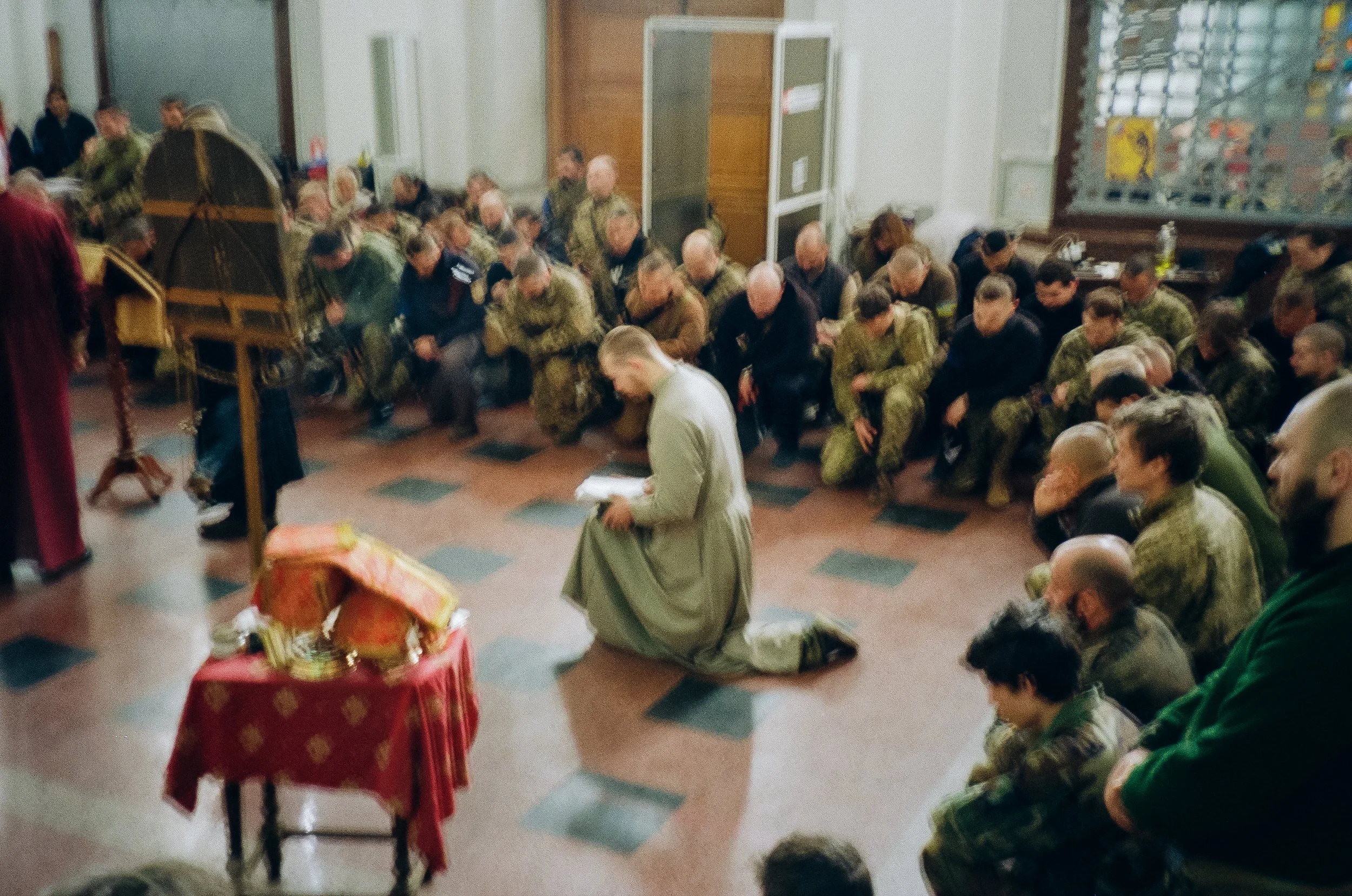
Bratsvo Battalion at mass before departing for an offensive in March of 2022. Photo by Masha Medvedeva
Love.
Love is not something you hear of often on the battlefield. The soldiers and officers of Bratsvo attribute love, for God, and for each other, as the foundation of their success, and even in their regard for their enemy.
Oleksiy Seredyuk, Bratsvo’s Commanding officer, sitting in the Battalion’s secret church in Kyiv, expounds on the motive power of love for a fighting organization “People are united by love, and for the sake of love people can go do great feats. And for some ideas they can too, but that takes a lot more propaganda machinery”. He observed this in his travels in the Middle East, where he found “terrorists, these scary ringleaders that we broadcast about on our TV channels, actually recruit people not through cruelty, they recruit people through love”.
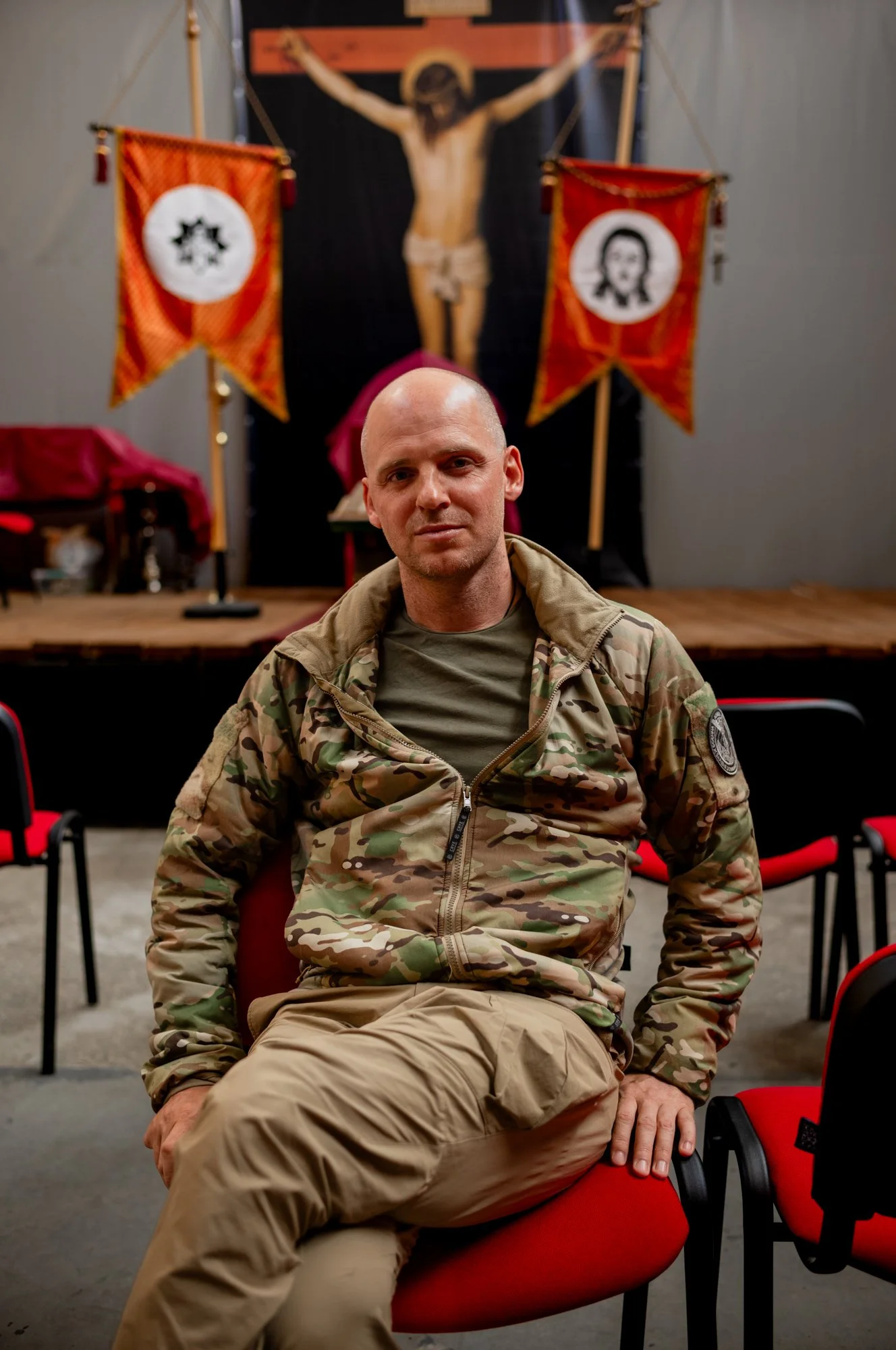
Oleksiy Seredyuk at Bratsvo Battalions Church in Kyiv, 2026
“Chorny,” Bratsvo’s second in command does not look older now in a Zaporizhzhia bunker in southern Ukraine than when I saw him in the first weeks of the Russian Invasion of 2022. He went into battle then with a 1918 dated Mosin-Nagant rifle so corroded it required a firm kick to load. He also went armed with civilian drones, guiding artillery onto Russian armored vehicles from above. “Chorny” does not look of this time either. He is thin, studious, with the intentional polished mannerism of a priest. Tomorrow being Sunday, he will play Chaplain for an hour while holding mass for the Bratsvo personnel not in trenches.
“Chorny” explains faith’s role in the Battalion: “I would say that it doesn’t help, it rules everything, everything happens because of this. While on assault missions, or important missions, they are eternally reading the prayer…If the mission continues for one month, people are switching, so that someone is eternally reading the prayer. This is the thing that saves us and this is the reason why miracles are happening sometimes”.
Explained further, Bratsvo maintains a group of volunteers who pray continuously, in hour long shifts for the duration of their most dangerous assignments.
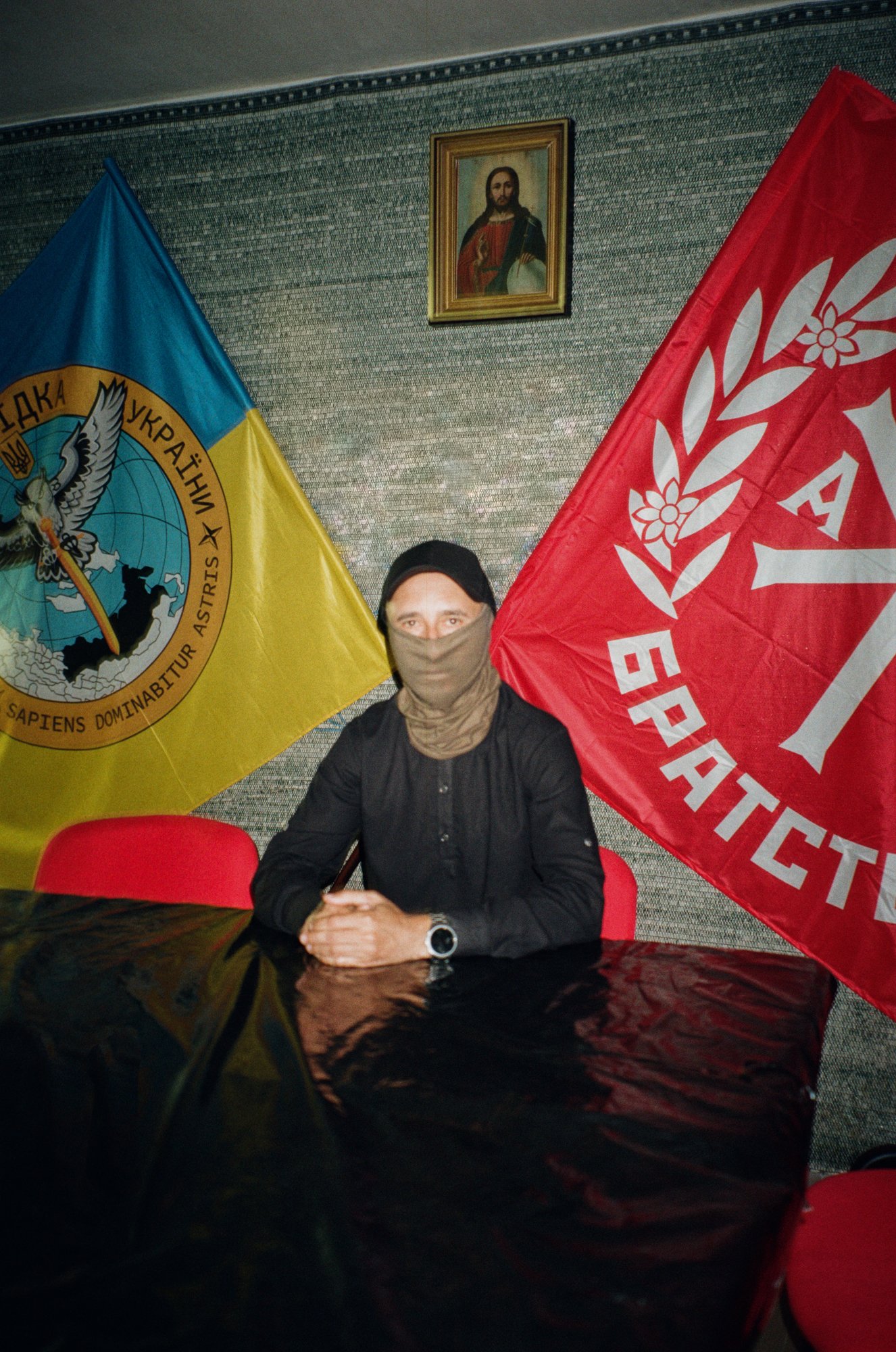
Chorny” at Bratsvo’s command bunker in Zaporizhzhia, 2026
Bratsvo, a volunteer unit at the beginning of the war, has since become a part of Ukraine’s secretive GUR (Defense Intelligence of the Ministry of Defense of Ukraine). The small unit made a name for itself conducting daring raids into occupied territory, most famously into Crimea using jet-skis.
Most infamously, the first publicly acknowledged mission into Russian territory ended in one of their small teams being killed by Russian security forces, becoming national heroes in the process. This reputation for daring missions elevated what had been a lesser-known and extremely controversial social organization into a household name. While their role as a specialized force taking on reconnaissance, sabotage, and diversion missions continues, like many Ukrainian special forces units, they also hold a section of the front line.
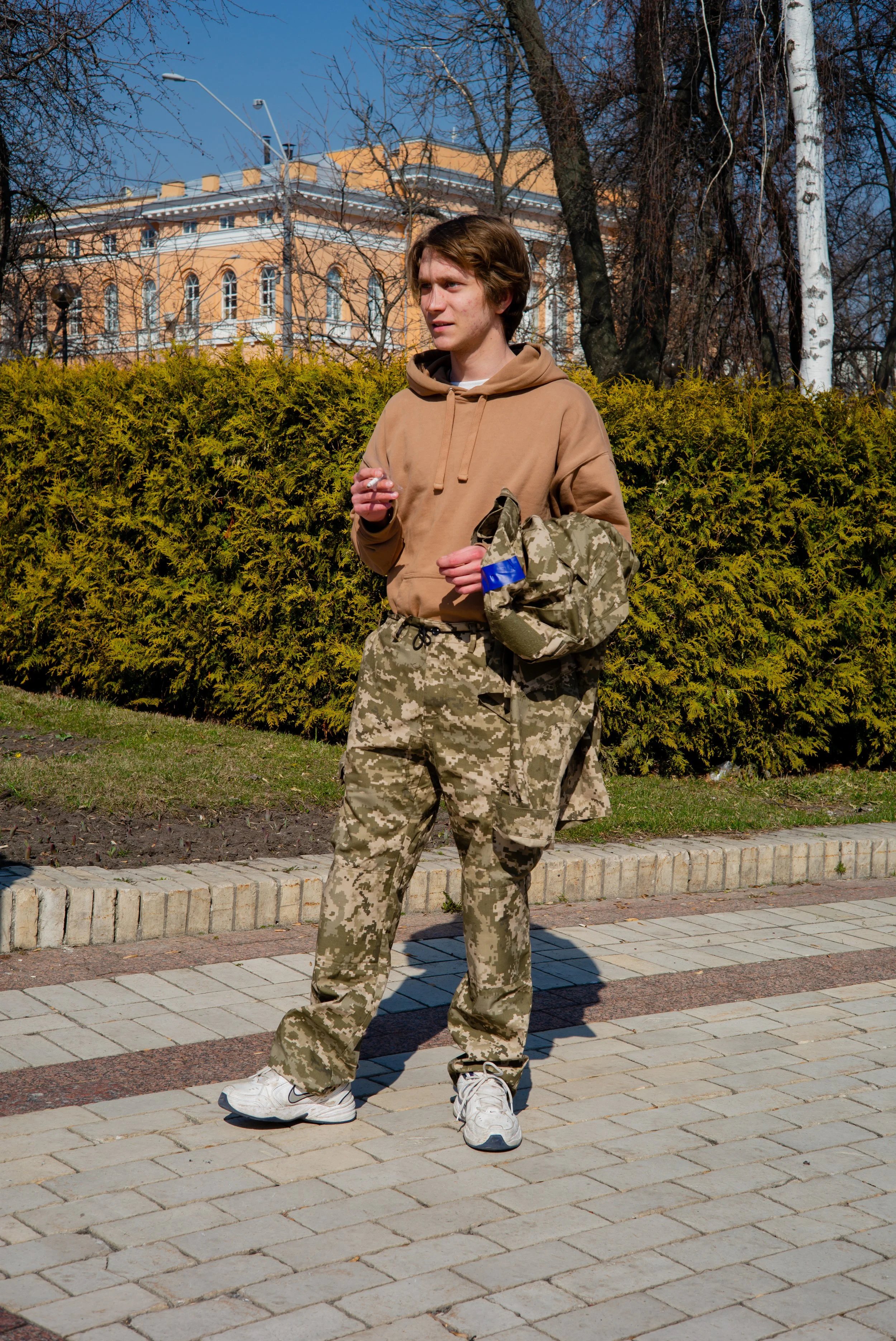
Bhdand "Apollon" Lyagov, aged 19, the youngest of the “Heavenly Four” who died on a mission deep inside Russia in 2022
Bratsvo’s faith-as-strategy is a novelty on a European battlefield, but it is also utilized objectively, and secularly, according to Seredyuk. Discussing the power of faith in terms of combat effectiveness, he recounts, “In practice we know how to take any people, from any nation, and build an incredible army out of them.”
He explains further, expanding from his own lessons advising foreign troops in a predominantly Muslim country he won’t disclose. He found their special forces lacked dedication, and asked instead for “people from the desert,” he continues: “We tell them about their faith, about their Allah, about whatever it is they believe in. And we say, all this training is nonsense. Faith is what matters most. Believing is what matters most. Let's pray together, whoever among you prays best, he'll be the senior one… And that's how we build the system. Very little time passes, very little, maybe a month. And it becomes the toughest unit, the most feared one, on that stretch of the front. I can rely on these people, they can carry out any heroic action”.
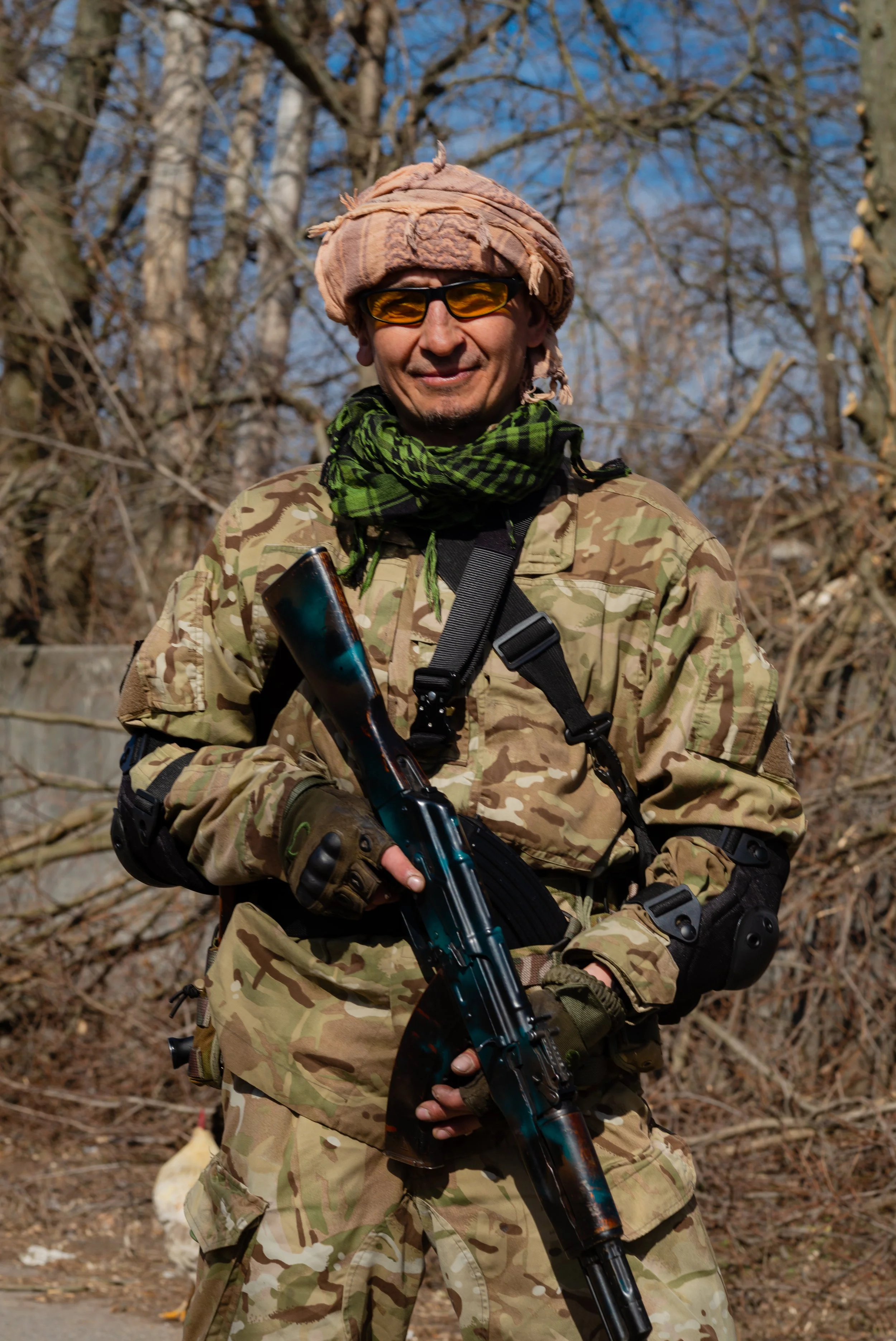
One of Bratsvo’s volunteer Muslim soldiers from the Dagestan region of Russia in March of 2022
This was not Bratsvo’s first time working with other monotheistic religions. In 2022 during the breakout of Kyiv they were joined by Muslim fundamentalists from the Dagestan region of Russia. Prior to the invasion, Bratsvo spokesman and political founder Dmytro Korchynsky had often referenced Islamic terrorist organizations such as the Taliban, or Hamas. Speaking to him in Kyiv between operations, he made his argument bluntly: Ukraine was going to be the guerrilla force in any war with Russia, and the faith based Taliban had defeated both Russia, and the United States. The Bratsvo strategy of faith, is neither blind, nor secular, but a well-researched theory in practice.
While there are a few protestant members of Bratsvo, a majority are Orthodox or Catholic. There are strictly no atheists. Bratsvo’s Commander Seredyuk explains "We take the highest thing there is — Christianity, and that gives us extraordinary capabilities. That's exactly why I'm very picky, very careful that there are no atheists or doubters in the unit. It has to be one monolith, one team, one army, one church” he continues “We select people specifically on a religious basis, that they are genuinely believing, practicing Christians. That gives us an incredible advantage among Ukrainians, among other units.”
Many Bratsvo soldiers claim to be drawn to the unit not only out of common faith, but as a way of deepening their spiritual relationship to God.
“Miner” has just returned from a rotation on a frontline position. He is towering. He has the leaden accent of Eastern Ukraine’s coal regions. His colossal proportions etched in Ukraine’s black dirt. He smells like 1000 cigarettes. The pouch dangling below his stained body armor is from a Chinese airsoft company. The armor placed inside it is Ukrainian. The jagged 2-inch piece of metal protruding from it is Russian.
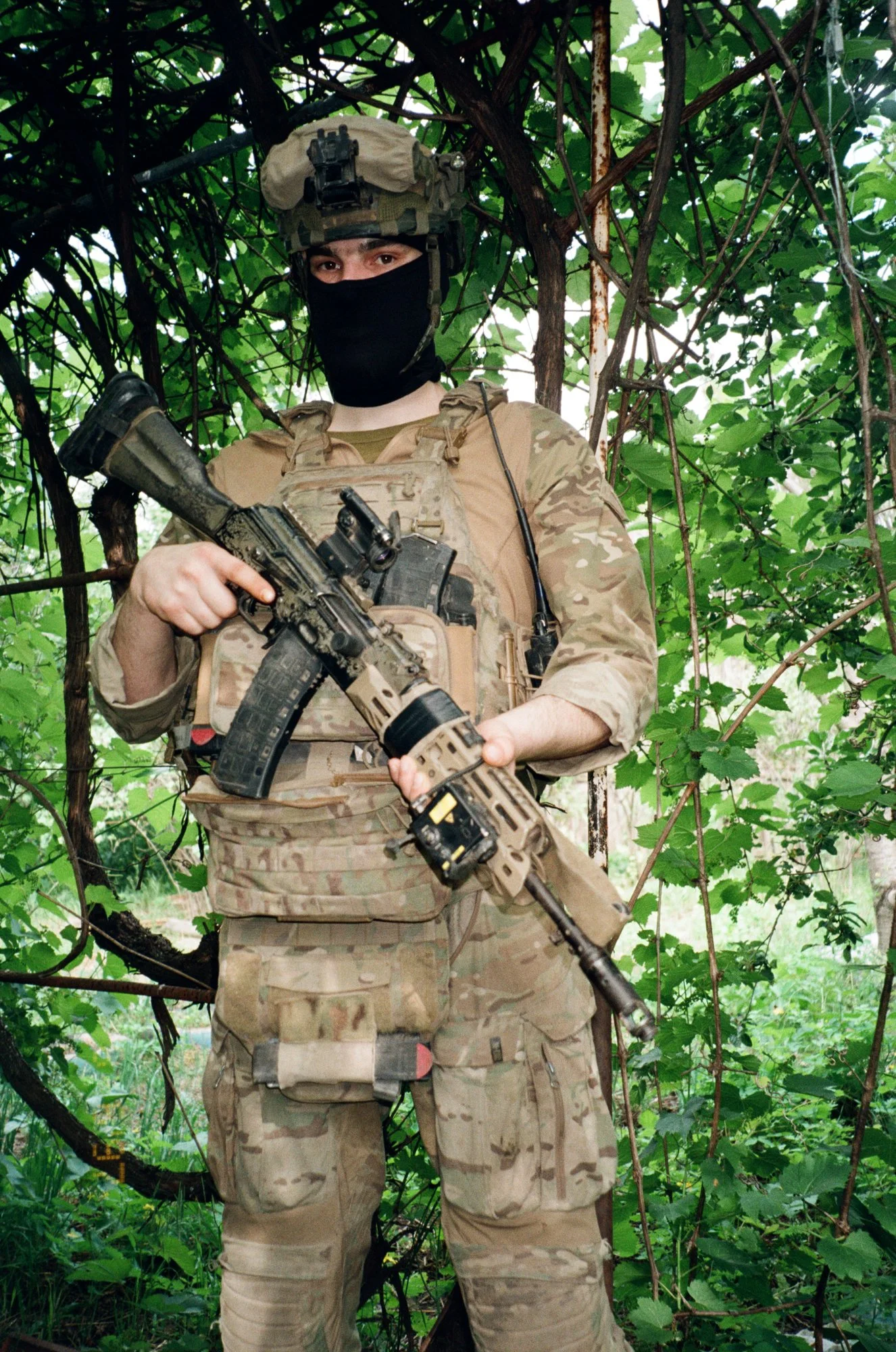
“Miner” a Bratsvo soldier recently returned from the frontline, 2026
He was already a soldier when the invasion started, and a miner before that. He says “Since I was child I had my face towards God”. He was following his own lifelong dream of joining an elite military unit when the invasion began. After 9 months of combat, he was discharged. He missed the war. He missed his friends, living and dead. He missed his rifle. But especially he missed feeling close to God. “Everyone feels close to god when a 152mm shells lands near you… but I had forgotten to thank him for everything. To thank him for falling asleep next to my wife”.
He joined Bratsvo and returned to war. He now serves in Bratsvo’s infantry, often undertaking reconnaissance missions alone.
On the wall of Bratsvo’s command bunker in Zaporizhzhia are stick figures tallied in marker. I am forbidden from photographing them, or listing their number. “Chorny’s" only comment is to point to a smaller tally of figures, and say “These are the ones we saved”.
“Fon” Bratsvo’s Drone Commander, is wearing a camouflage shirt comprised of earth toned cats. War does not seem to have aged him. His eyes are free of the usual black bags and cigarette creased corners. His voice has the inflection of pride when he says his primary job is “To defend our infantry.”
Drones in Ukraine have become synonymous with videos of stunned soldiers and tired vehicles bieng atomized in montage compilations. “Fon” highlights that most of their workload now is logistics: delivering the bullets, beans, and bandages that keep their infantry fighting in their isolated positions for months at a time. Making deliveries to keep up morale is important too, “Fon” beams, recalling delivering fresh-baked Easter Baskets.
But the usual drone payload is explosive, not baked goods.
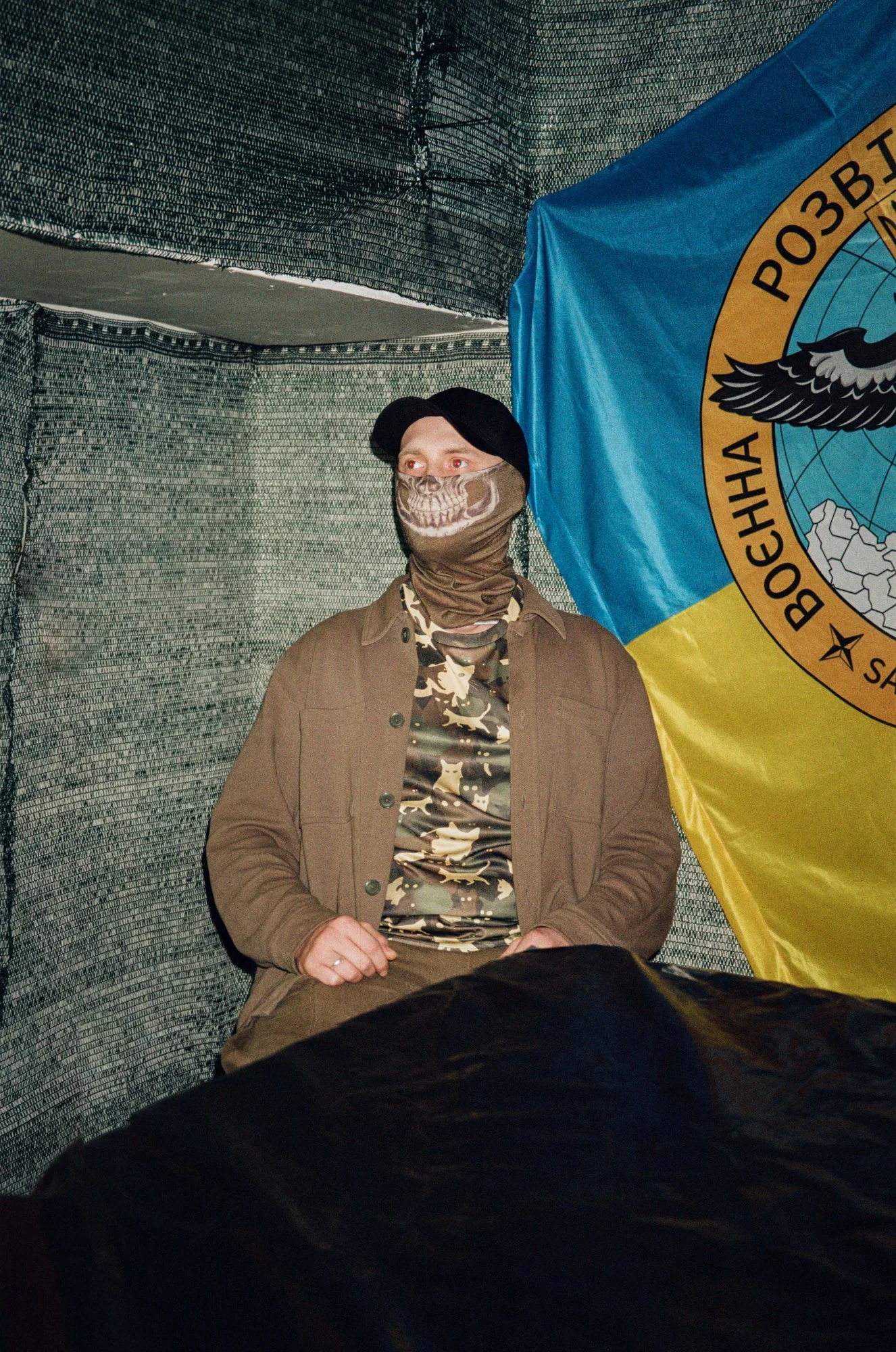
Fon” A Bratsvo Drone Commander in Bratsvo’s command bunker in Zaporizhzhia, 2026
How does he feel, a devout Christian, killing Russian Christians? “If you kill one it is passion, if you kill 100 it’s a job”
There are other jobs he prefers and prioritizes, saying “If the choice is supporting our infantry positions or killing a fagot (popular slang for Russian soldiers) I will support our positions, he will live one more day”
Back in the Battalion's secretive church, Oleksiy Seredyuk responds to how his soldiers fare with the psychological tolls of this war. He says no Bratsvo soldiers have suffered from PTSD and explains further: “Our faith gives us context. It’s like making love. Every day millions of people do it and they are fine. But if someone is forced to, this everyday act becomes rape and it becomes traumatic. Our soldiers understand why they are fighting, its purpose, and their volition in it”
There are no atheists in foxholes, and there are no soldiers that have seen combat and not prayed to God, or any God, for something. “Concrete” says he has “Learned to listen more than ask” and he adds “It’s better to pray for small, specific things”
“Concrete” age 24, is one of Bratsvo’s longest standing members and one of youngest soldiers, having joined when the unit was a social organization years before the full scale invasion. “Concrete” is now a platoon commander for one of Bratsvo’s Infantry platoons. He also serves as one of the Battalion’s medics and highlights the battalion’s unusually low casualty numbers.
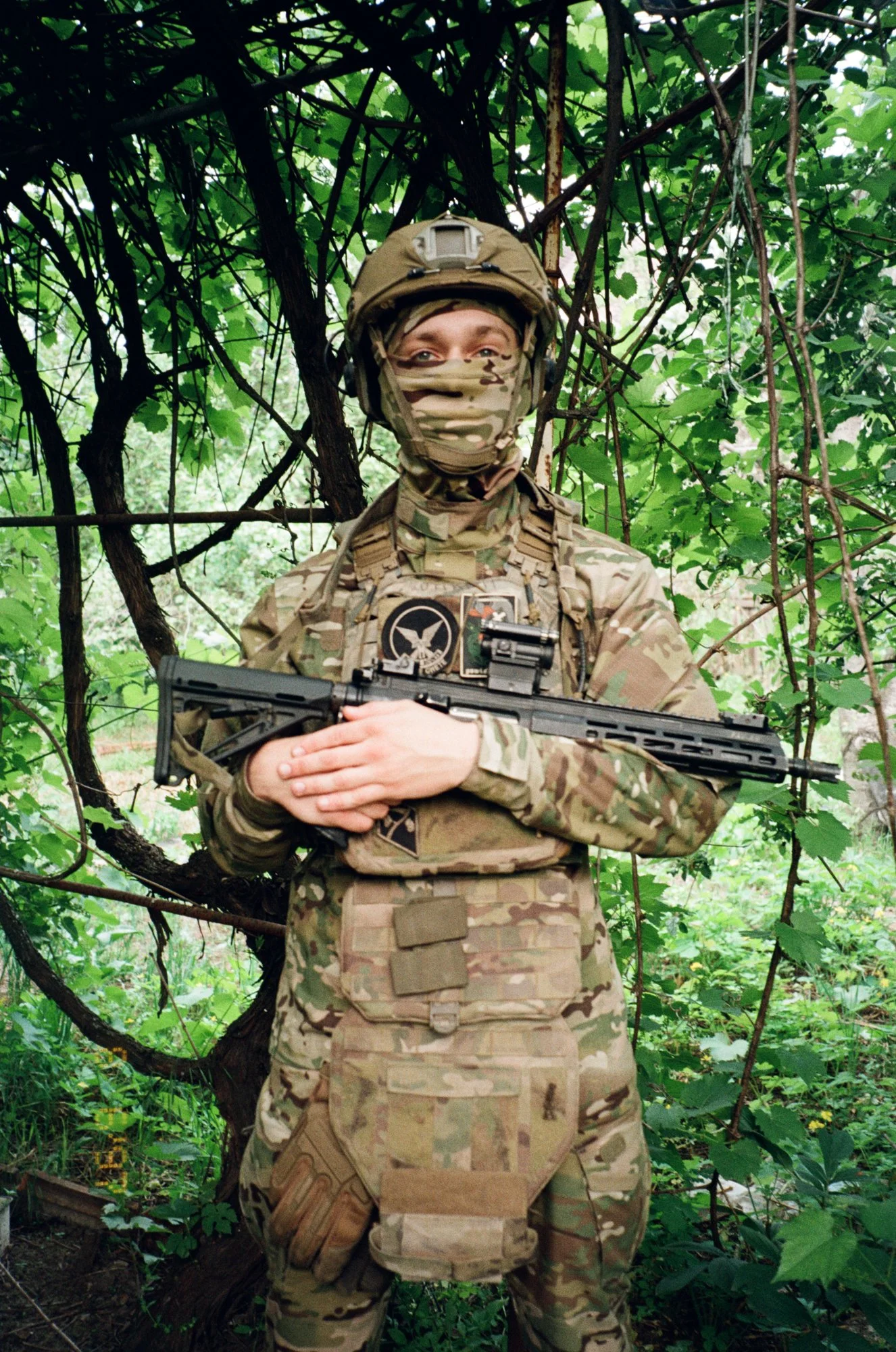
Concrete” aged 24, and a Bratsvo Platoon commander, photographed in Zaporizhzhia, 2026
“In total in the last three months we made only one evacuation, because we have had only one wounded guy”.
Bratsvo casualties, like all Ukrainian units, are forbidden from being published, but for both the line infantry missions, and their commando missions conducting raids and reconnaissance, their casualties are roughly half to a quarter of similar units I have experience with in 2025 and 2026.
Concrete espouses forgiveness as a fundamental Christian value. In terse sentences and between forceful pauses, he says “Preferable over the phone, or behind a fence, outside of our country, if a Russian soldier asked forgiveness, I would forgive him”.
Bratsvo’s Commanding Officer Seredyuk frames love as a tool equally for friends and foes “…over the course of the war my view changed, and my fighters' views changed too. And now we treat (Russian) prisoners with enormous respect, we don't torture them, we give them tea and congratulate them on having survived….we try to show them, in every way we can, our respect and, I'd even say, love..But none of that changes the fact that yes, we do kill them, and I think we're one of the most effective….brutally so”
Faith in the Bratsvo Battalion is not blind, or blindly following, but objectively utilized with measurable effect. Miracles and martyrs here have a place behind the benefits of a strong shared faith, shared purpose, high morale, moral authority, in a unit that has learned, in the words of “Concrete" “To listen more than to pray, and to pray for very small, specific things.”
"Chorny" begins to conclude his Sunday sermon. The underground bunker seems to hum still with rhythmic prayer. His sermon is short, the men are quiet, their attention to "Chorny" is tangibly magnetic. "Chorny" speaks of Christianity’s discord in the early 20th century, insisting on love, brotherhood, and unity.
“If others see this, it is a great thing and they will act similarly, with love and brotherhood.”
Would the war be different if other Ukrainian units shared Bratsvo’s fundamentalist faith? "Chorny" responds:
“I think that in the case, if the units would have the same spiritual, mental understanding as we do, the war would be over a long time ago, somewhere over the Urals”.
Referring to the long distant Russian mountain range, he cracks a rare smile.
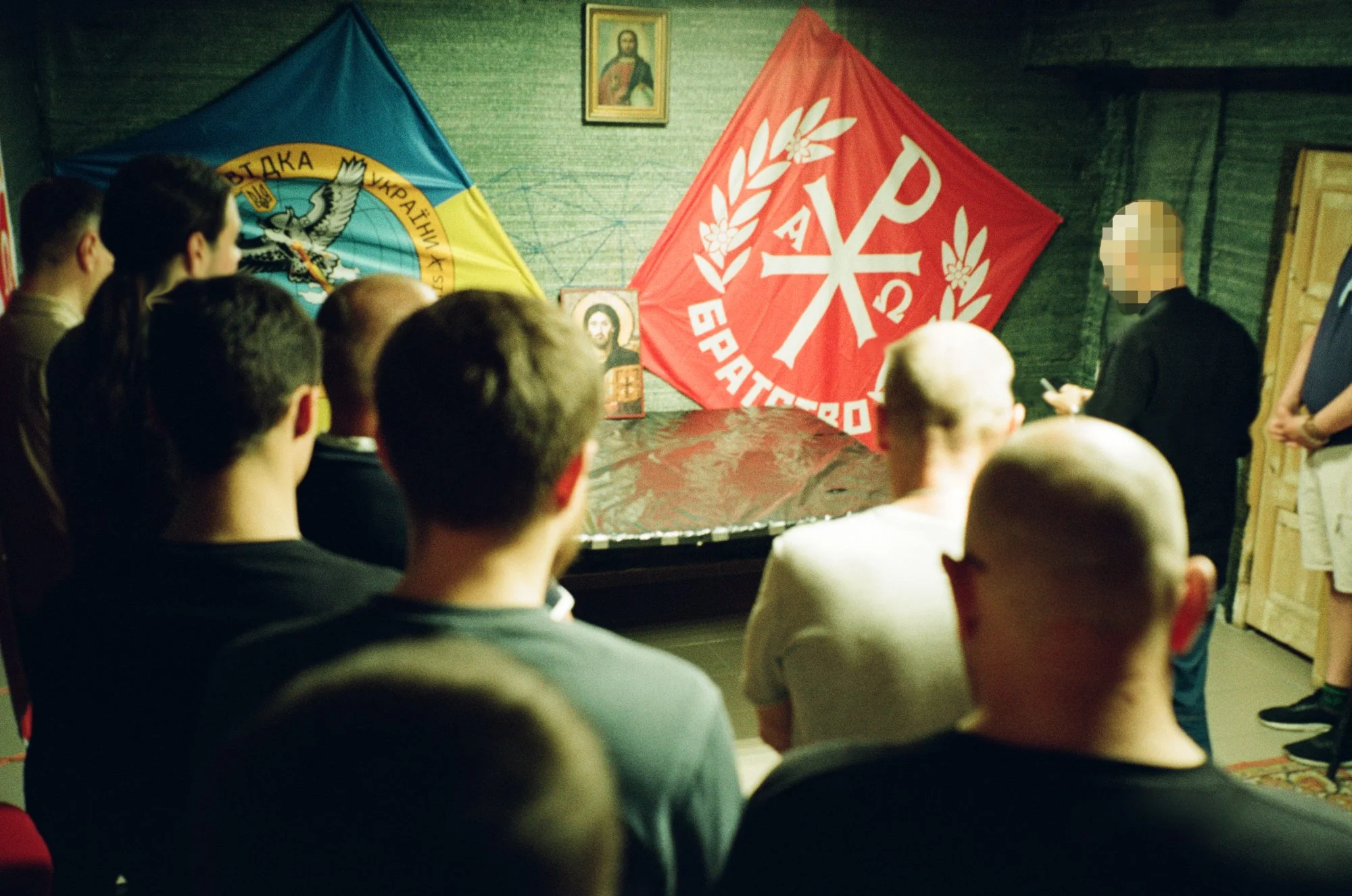
Chorny” leading Bratsvo soldiers in prayer at Bratsvo’s command bunker in Zaporizhzhia, 2026
Notes from the Frontsight Editors: names inside of quotes are personal callsigns, commonly used by soldiers in Ukraine. They function as nicknames but also protect individual identities.
The profanity used in this story is is the commonly used Ukrainian slang for Russians: “Pedarov”